CONFERENCE PROCEEDING
Production of new carbon-magnetic particles and their immunoanalytical application
1
A.N. Bach Institute of Biochemistry, Research Center of Biotechnology of the Russian Academy of Sciences, Moscow, Russia
Publication date: 2026-07-30
Public Health Toxicol 2026;6(Supplement 1):A5
KEYWORDS
ABSTRACT
Introduction:
Conjugates of magnetic particles (MPs) with antibodies are effective components of analytical systems, providing selective binding of controlled compounds from large sample volumes, simple and rapid concentration upon application of an external magnetic field. The use of native metal MPs for conjugation is complicated by their tendency to aggregation and relatively low optical density. In this study, we studied the possibilities of modifying MPs with fullerene C60, which isolates the MPs surface from oxidation and provides an intense black color of the product.
Methods:
The preparation of unmodified MPs was obtained by thermal decomposition of a 2% solution of iron pentacarbonyl in dimethyl sulfoxide (DMSO). The reaction was implemented at 130 °C with the formation of iron oxide and carbon dioxide. Fullerene-coated MPs were obtained by boiling together at 130 °C a 2% solution of iron pentacarbonyl and a 10% solution of C60 in a mixture (50/50 v/v) of DMSO and toluene. The solution was colored first yellow, and then black-violet. The MPs coated with C60 were precipitated using a magnet and washed first with DMSO, then with water. Based on the obtained MPs and MP@C60, conjugates of the particles with anti-species antibodies were synthesized by adsorption for testing in the format of immunochromatographic analysis.
Results:
The synthesis of modified MPs was carried out according to the following scheme: The hydrodynamic diameters of MPs and MP@C60 were 190±52 nm and 733±190 nm, respectively. The efficiency of magnetic separation of the synthesis products from their colloidal solutions was confirmed. The obtained preparations of conjugates of MPs and MP@C60 with anti-species antibodies were characterized in the immunochromatographic system. It was shown that the intensity of staining of the binding zone when using MP@C60 is 5 times higher compared to using MP, which confirms the advantages of MP@C60 as analytical markers.
Conclusions:
An effective method for obtaining contrast-colored MP@C60, which combines magnetic and colorimetric properties of the original components, is proposed. These preparations are promising components of immunoanalytical systems.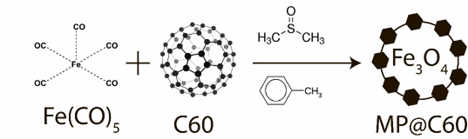
Conjugates of magnetic particles (MPs) with antibodies are effective components of analytical systems, providing selective binding of controlled compounds from large sample volumes, simple and rapid concentration upon application of an external magnetic field. The use of native metal MPs for conjugation is complicated by their tendency to aggregation and relatively low optical density. In this study, we studied the possibilities of modifying MPs with fullerene C60, which isolates the MPs surface from oxidation and provides an intense black color of the product.
Methods:
The preparation of unmodified MPs was obtained by thermal decomposition of a 2% solution of iron pentacarbonyl in dimethyl sulfoxide (DMSO). The reaction was implemented at 130 °C with the formation of iron oxide and carbon dioxide. Fullerene-coated MPs were obtained by boiling together at 130 °C a 2% solution of iron pentacarbonyl and a 10% solution of C60 in a mixture (50/50 v/v) of DMSO and toluene. The solution was colored first yellow, and then black-violet. The MPs coated with C60 were precipitated using a magnet and washed first with DMSO, then with water. Based on the obtained MPs and MP@C60, conjugates of the particles with anti-species antibodies were synthesized by adsorption for testing in the format of immunochromatographic analysis.
Results:
The synthesis of modified MPs was carried out according to the following scheme: The hydrodynamic diameters of MPs and MP@C60 were 190±52 nm and 733±190 nm, respectively. The efficiency of magnetic separation of the synthesis products from their colloidal solutions was confirmed. The obtained preparations of conjugates of MPs and MP@C60 with anti-species antibodies were characterized in the immunochromatographic system. It was shown that the intensity of staining of the binding zone when using MP@C60 is 5 times higher compared to using MP, which confirms the advantages of MP@C60 as analytical markers.
Conclusions:
An effective method for obtaining contrast-colored MP@C60, which combines magnetic and colorimetric properties of the original components, is proposed. These preparations are promising components of immunoanalytical systems.
CONFLICTS OF INTEREST
The authors declare no conflicts of interest.
FUNDING
The work was carried out with the financial support of the Russian Science Foundation (project No. 24-23-00523).
Share
RELATED ARTICLE
| eISSN: | 2732-8929 |

We process personal data collected when visiting the website. The function of obtaining information about users and their behavior is carried out by voluntarily entered information in forms and saving cookies in end devices. Data, including cookies, are used to provide services, improve the user experience and to analyze the traffic in accordance with the Privacy policy. Data are also collected and processed by Google Analytics tool (more).
You can change cookies settings in your browser. Restricted use of cookies in the browser configuration may affect some functionalities of the website.
You can change cookies settings in your browser. Restricted use of cookies in the browser configuration may affect some functionalities of the website.